
|
|
An 8 second occultation was recorded by Bill Allen, using CCD driftscan technique.
View the updated prediction.
Observers:
  1    B Allen,Blenheim, NZ
  2(P) Prediction
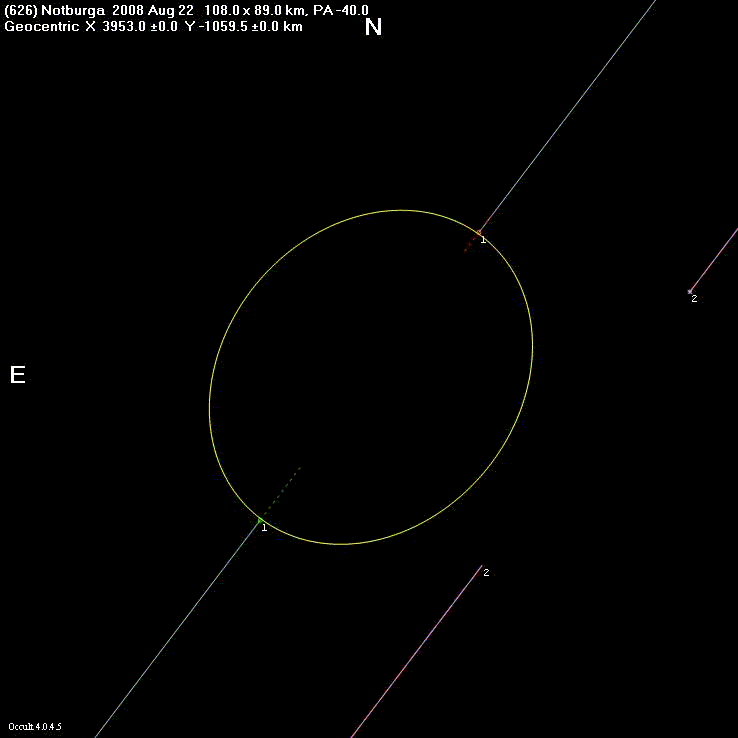
Discussion:
The ellipse above is plotted at the a shape that matched the published parameters. This has an area within 1% of the expected 100 km diameter of Notburga. With only one chord it is not possible to determine whether Bill was north or south of the central line of the event. However, assuming the updated prediction was approximately correct and the longer than expected chord of about 110 km would suggest that the chord might lie close to the central portion of the asteroid.
The figures below show the drift-scan image of the occultation together and the data as analysed by Bill's alyser software.
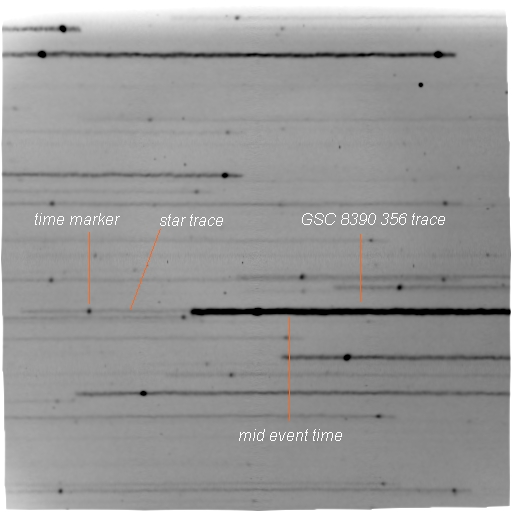
As you can see the drift trace of the target star was severely "smudged" by a much brighter nearby star, a little to the East. This may have meant a lost observation. However when the picture is scanned and the data plotted we can see a small dip close to the expected time.
.gif)
There is even the hint of a possible R/D blink in the middle may suggest a graze event and which seems unlikly given the fit above. If we take the indicated D and R points on this graph we see the event is close to the predicted path above.
Observational Data:
Observation details for MP (626) Notburga
By Star              UCAC2 12572951
On 2008-08-22  at 13:50:31.0
_______________________________

Observer   Bill Allen
Location   Blenheim, NZ
Longitude  +173:50:21.4
Latitude   -41:29:30.
Altitude   38 m
Datum      WGS84
Telescope SCT including Cass and Mak
Aperture   40 cm
Seeing     Steady Clear
Timing     Tape Recorder + time signal Drift scan
Disappearance  13:50:26.3
Reappearance   13:50:34.5
Comments:
Datum NZ1949 (topographical map)(Corrected to WGS84 jt)
Very good observing conditions
Manual synchronisation of Timer Box to KIWI-OSD time to better than 0.1 second.
MISS or OCCULTATION ? It was very difficult to be sure as the drift scan trace
merged with the bright 9.32 magnitude star GSC 8390 356
obscuring the event. On closer exmination of the light curve there may
have been an 8 second occultation.