
|
|
Updated: 2014 Oct 05, 10:05 UT
Event Rank : 99
(The event Rank is a measure of the likelihood of observing an event, and is equal to the probability of at least one successful observation by a team of two observers spaced 1/8 path width just inside opposite sides of the predicted path. An event rank of 100 indicates that the prediction is expected to be very accurate).
THE UPDATED PATH
Note: The duration given in the line below is the interval during which the occultation shadow sweeps across the Earth - please see the minute markers on the map to determine the approximate time for your location.
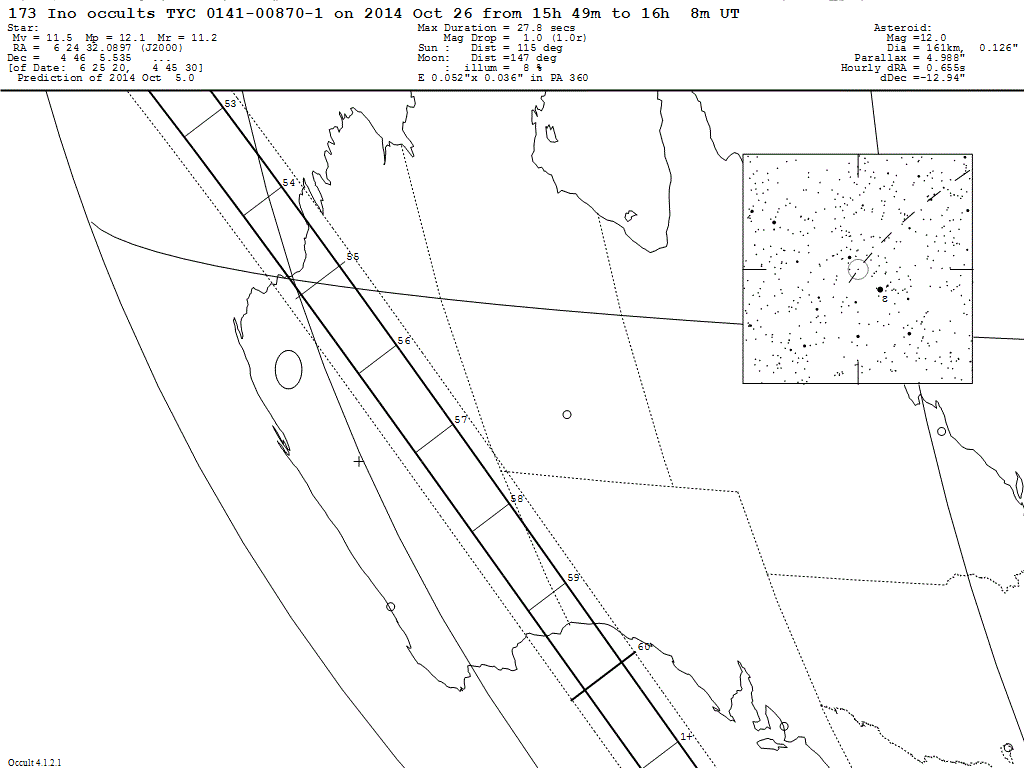
On 2014 Oct 26 UT, the 161 km diameter asteroid (173) Ino will occult a 11.5 mag star in the constellation Monoceros for observers along a path across West Australia and western South Australia, passing over Broome.
In the case of an occultation, the combined light of the asteroid and the star will drop by 1.0 mag to 12.0 mag (the magnitude of the asteroid) for at most 27.8 seconds.
This update is based on UNSO/Flagstaff astrometry for the asteroid kindly provided by Alice Monet, historical astrometry from the MPC files (via AstDys), and the following catalogs for the star position: UCAC.
Additional details of this and other events are available at Steve Preston's website at http://www.asteroidoccultation.com/
EVENT DETAILS SUMMARY :Important Note regarding Accuracy:
The uncertainty interval in path widths given above (and shown as a 1-sigma uncertainty ellipse on the plot) refers to RMS deviation and is applied as a +/- range. In other words, a path uncertainty of 1.0 path widths means that the actual center of the asteroid's shadow path should fall within plus or minus 1 path width of the plotted path center. However path errors larger than 1 sigma have been observed so observers should be alert for primary occultations within plus or minus 3 sigma of the updated path.
Further, almost all asteroidal satellites discovered so far have been found within 10 diameters of the asteroid (since this distance is deep enough within the gravitational well to be stable over long timescales). Therefore, if monitoring for secondary events, observing out to about 10 path-widths either side of the predicted track remains worthwhile.
We therefore recommend that you monitor for events if your observing location is up to +/- 10 path-widths from the predicted track. If not monitoring for occultations by secondary bodies you should observe from locations within 3 sigma of the nominal path.
In terms of time, the predictions are now usually accurate to about +/- 0.3 minute so you should be most attentive during the predicted minute of the event. However if intending to catch a potential satellite occultation you should start observing at least 10 times the predicted central duration before the predicted closest approach time for your location, and continue for a similar period afterwards.
 Occultation of TYC 0141-00870-1 by 173 Ino on 2014 Oct 26
                  Centre              Star  Star   Sun      Path Limits           Error Limits
  E. Longitude   Latitude      U.T.    Alt    Az   Alt    Limit 1    Limit 2    Limit 3    Limit 4
      o  '  "     o  '  "    h  m  s     o     o     o    o  '  "    o  '  "    o  '  "    o  '  "
                                                        Longitude  Longitude  Longitude  Longitude
    130  9 38   -37  0  0   16  1  5    27    60   -39  128 12 43  132  0 58  126 49 29  133 13 55
    129 58 50   -36  0  0   16  0 46    27    61   -40  128  2 42  131 49 25  126 40  0  133  1 52
    129 45 57   -35  0  0   16  0 27    27    62   -41  127 50 24  131 35 56  126 28  6  132 47 59
    129 31  0   -34  0  0   16  0  8    28    62   -42  127 35 51  131 20 33  126 13 49  132 32 17
    129 13 59   -33  0  0   15 59 48    28    63   -43  127 19  4  131  3 15  125 57  8  132 14 47

    128 54 54   -32  0  0   15 59 28    28    64   -44  127  0  1  130 44  3  125 38  3  131 55 27
    128 33 43   -31  0  0   15 59  7    28    65   -45  126 38 41  130 22 55  125 16 33  131 34 18
    128 10 25   -30  0  0   15 58 46    28    65   -46  126 15  2  129 59 49  124 52 33  131 11 18
    127 44 56   -29  0  0   15 58 25    28    66   -47  125 48 59  129 34 44  124 26  0  130 46 24
    127 17 13   -28  0  0   15 58  4    28    67   -48  125 20 29  129  7 36  123 56 48  130 19 34

    126 47 11   -27  0  0   15 57 42    28    68   -49  124 49 26  128 38 21  123 24 50  129 50 44
    126 14 45   -26  0  0   15 57 20    28    69   -50  124 15 41  128  6 54  122 49 58  129 19 51
    125 39 46   -25  0  0   15 56 58    28    70   -52  123 39  6  127 33 10  122 12  0  128 46 48
    125  2  7   -24  0  0   15 56 36    27    71   -53  122 59 29  126 57  2  121 30 43  128 11 30
    124 21 36   -23  0  0   15 56 13    27    72   -54  122 16 37  126 18 20  120 45 50  127 33 49

    123 38  0   -22  0  0   15 55 50    27    72   -55  121 30 13  125 36 55  119 57  0  126 53 37
    122 51  4   -21  0  0   15 55 26    26    73   -56  120 39 55  124 52 34  119  3 46  126 10 42
    122  0 29   -20  0  0   15 55  3    26    74   -57  119 45 17  124  5  2  118  5 33  125 24 51
    121  5 50   -19  0  0   15 54 39    25    75   -58  118 45 45  123 14  2  117  1 37  124 35 51
    120  6 36   -18  0  0   15 54 15    24    76   -59  117 40 34  122 19 10  115 50 55  123 43 22

    119  2  9   -17  0  0   15 53 50    23    77   -60  116 28 44  121 20  0  114 32  3  122 47  0
    117 51 36   -16  0  0   15 53 25    22    78   -62  115  8 50  120 15 55  113  2 51  121 46 19
    116 33 48   -15  0  0   15 53  0    21    79   -62  113 38 51  119  6 10  111 19 58  120 40 41
Uncertainty in time = +/- 12 secs

Prediction of 2014 Oct  5.0
Use these links for further information:
[Planetary Occultations]
[Using the Predictions]
[Observing Details]
[Timing Details]
[Reporting Details]
[Report Form]
[Asteroid Occultation Results]
[Top of Page][Return to Home Page]